A guide to the directory
A map of delirium tools
Start with the question you need a tool to answer. Select an island or read the groups below.
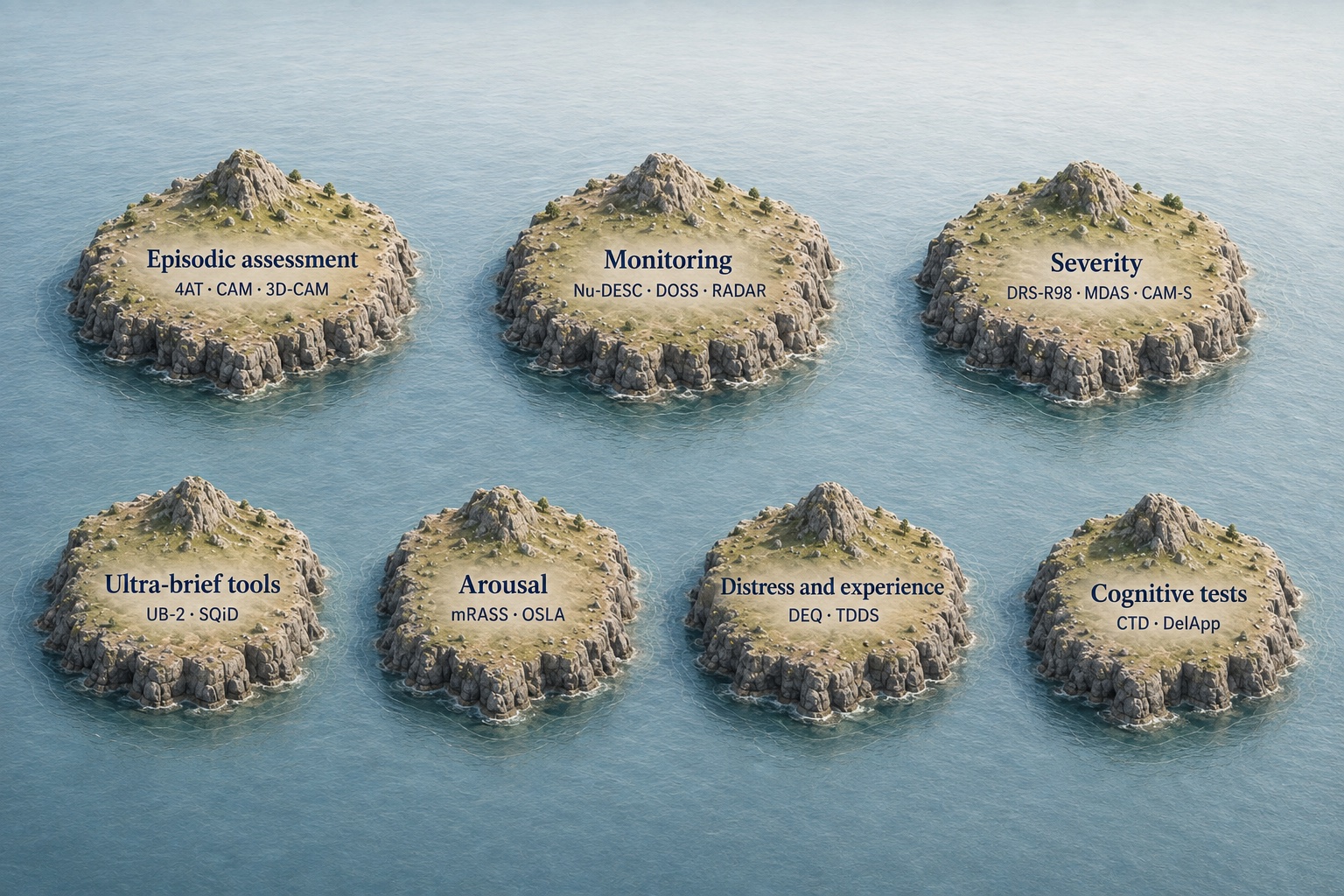 Episodic assessment: explanation and toolsMonitoring: explanation and toolsSeverity: explanation and toolsUltra-brief tools: explanation and toolsArousal: explanation and toolsDistress and experience: explanation and toolsCognitive tests: explanation and tools
The position and size of each island do not indicate the strength of evidence.
Episodic assessment
Assess possible delirium now.
A structured assessment at a particular point in time. It may be repeated when clinically indicated. The required interview, cognitive tests and history remain part of the procedure.
Examples: 4AT, CAM, 3D-CAM, bCAM, CAM-ICU.
CAM usually means the four-feature short CAM. The long CAM has ten items. Both require a preceding interview with cognitive testing. Short and long CAM explained.
Browse this group →Monitoring
Notice new or changing features during care.
Observation over time can prompt assessment. The best tool, frequency and response pathway are not settled. A monitoring score should not delay action on a new concern.
Examples: NuDESC, DOSS, RADAR.
Browse this group →Severity
Measure the extent of delirium symptoms.
Severity ratings can describe change and support research. They measure a different outcome from a yes-or-no delirium assessment. Some instruments serve both purposes.
Examples: DRS-R-98, MDAS, CAM-S.
Browse this group →Ultra-brief tools
Identify a reason for fuller assessment.
A very short test or question can form the first stage of a pathway. A positive result often needs a second assessment. A negative result must be interpreted in context.
Browse this group →Arousal
Describe alertness or responsiveness.
Arousal is important in delirium assessment, but an arousal score alone does not establish delirium. RASS also has an established role in assessing agitation and sedation in intensive care.
Browse this group →Distress and experience
Understand what delirium is like for people.
These instruments address distress, recall or experience. The respondent may be a patient, family member or staff member. Timing and ability to give an account matter.
Browse this group →Cognitive tests
Examine attention and other cognitive functions.
Tests and batteries can help characterise cognitive impairment. Results need clinical context: an abnormal cognitive score alone cannot distinguish delirium from dementia or other causes.
Browse this group →Other ways to find a tool
These seven groups are a starting point. Setting, age, information source and purpose overlap. The full directory also covers motor subtype, retrospective assessment, aetiology and related methods.