← All public profiles

RADAR: Recognizing Acute Delirium As part of your Routine

2015

Three-item tool completed by nursing staff during medication rounds; developed for feasibility and acceptability in busy settings.

At a glance

Purpose
Episodic assessment
Population
Adult
Setting
General / acute hospital, Long-term / care home
Time
~7 sec
Items
3
Score or threshold
RADAR positive (participant-level collapse)

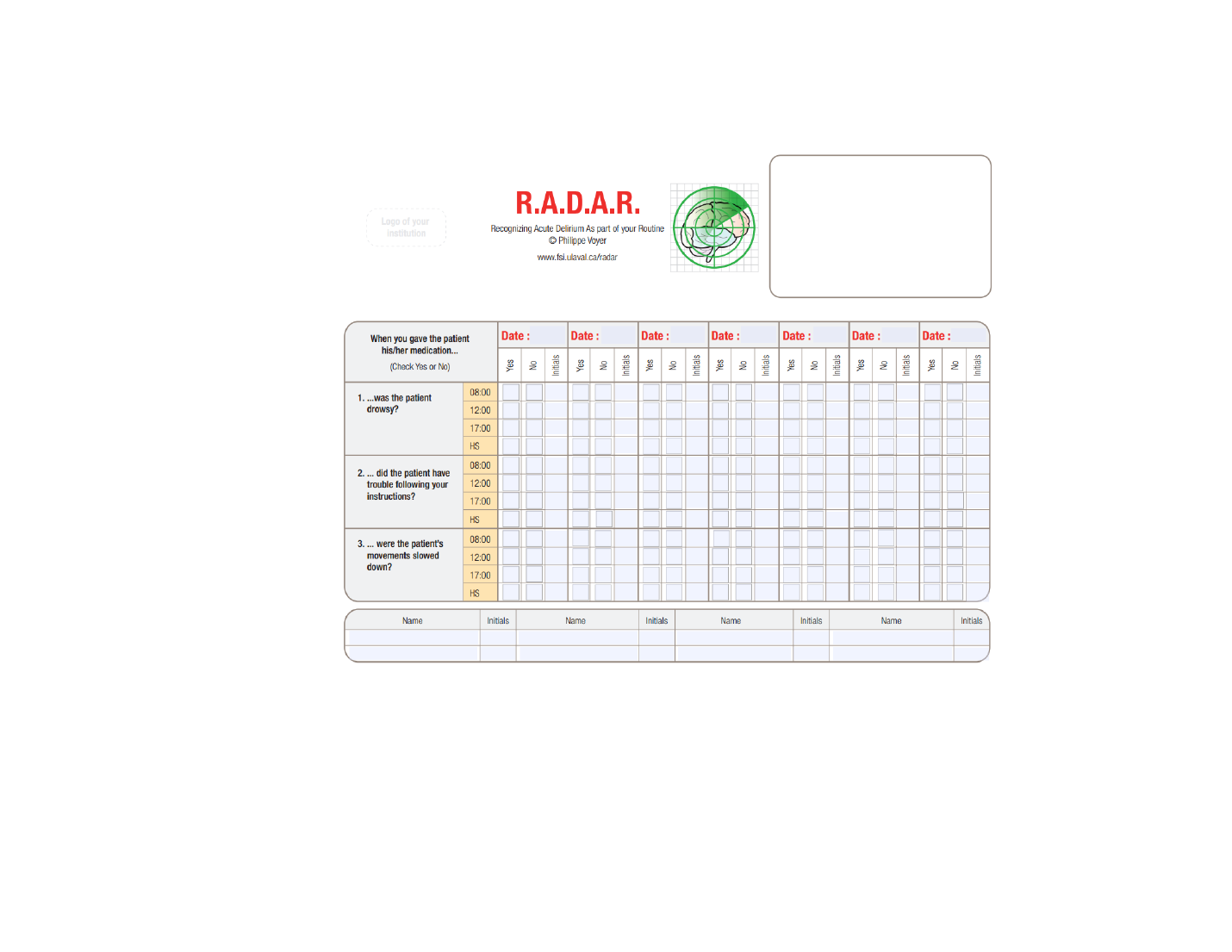
Format: Usually presented as a landscape weekly observation chart. Three yes/no nursing observations are recorded at medication rounds across several days, with spaces for date, time, and staff initials.

CAM usually means the four-feature short form; the long form has ten items. Check which form and supporting assessment the study used. Short and long CAM explained.

Primary validation papers

3 identified diagnostic-accuracy papers

Other forms of validation are described in the evidence section. What is counted?

Large-scale clinical implementation

None identified in the scoped review.

None identified in the selected profile sources and the Penfold general-hospital review. This is not a completed search of all settings or later papers.

Training and instructions

  • RADAR teaching materials and videos. Developer page with French-language teaching resources and links to other versions.
  • RADAR form. Public instrument material checked on 5 September 2026. Follow the source’s version and permission conditions.
Start here

Tool and original sources

The complete tool is shown below and can be opened as a full-size file. The linked licence states the terms for reuse and attribution.

Original paper

  • Original paperVoyer P, Champoux N, Desrosiers J, Landreville P, McCusker J, Monette J, et al. Recognizing acute delirium as part of your routine [RADAR]: a validation study. BMC nursing. 2015;14:19. doi: 10.1186/s12912-015-0070-1. PMID: 25844067.

    This paper reports the original validation of RADAR. It is the main source for the method, its intended use and the evidence available at publication.

    Article PDF: CC BY. This licence applies to the article PDF and does not grant rights to reproduce the tool.

Multiple DTA studies identifiedCore instrument family
Preview of the RADAR weekly nursing observation chart
RADAR (Recognizing Acute Delirium As part of your Routine), Voyer P, Champoux N, Desrosiers J, Landreville P, McCusker J, Monette J, Savoie M, Richard S and Carmichael PH, supplementary material to BMC Nursing 2015;14:19, https://doi.org/10.1186/s12912-015-0070-1, licensed under CC BY 4.0. Preview converted from DOCX and resized for web display.
Classification

Classification

A tool may belong to more than one category. Select a linked category to see other relevant profiles.

Evidence

Diagnostic-accuracy evidenceMultiple DTA studies identified

Reported sensitivity and specificity

73%
Sensitivity
67%
Specificity

Original validation, n=193; vs DSM-IV-TR.

More evidence and citation details
Full name
Recognizing Acute Delirium As part of your Routine
Also known as
RADAR
Related profiles
RMA
Evidence summary
multi
Diagnostic-accuracy evaluations
3
Reference standard
Independent research-assistant delirium classification using repeated CAM, Hierarchic Dementia Scale, chart, family and staff information over seven hours
Citation
Voyer P, Champoux N, Desrosiers J, Landreville P, McCusker J, Monette J, Savoie M, Richard S, Carmichael PH Recognizing acute delirium as part of your routine [RADAR]: a validation study BMC nursing. 2015;14:19. PMID 25844067

Primary validation studies

Distinct primary publications from the current diagnostic-accuracy audit. Reviews and repeated evaluations within one paper are not counted again. Overlapping cohorts have not all been reconciled. Read the counting rules and limitations.

Open 3 identified papers
  1. Voyer P, Champoux N, Desrosiers J, Landreville P, McCusker J, Monette J, Savoie M, Richard S, Carmichael PH (2015). Recognizing acute delirium as part of your routine [RADAR]: a validation study. BMC nursing.

    Reference category: other comparator or secondary accuracy evidence.

  2. Voyer P, Champoux N, Desrosiers J, Landreville P, McCusker J, Monette J, Savoie M, Carmichael PH, Richard H, Richard S (2016). RADAR: A Measure of the Sixth Vital Sign?. Clinical nursing research.

    Reference category: other comparator or secondary accuracy evidence.

  3. Fabrizi D, Rebora P, Spedale V, Locatelli G, Bellelli G, Di Mauro S, Ausili D, Luciani M (2024). Diagnostic Accuracy of the Recognizing Acute Delirium as Part of Your Routine (RADAR) Scale for Delirium Assessment in Hospitalized Older Adults: A Cross-Sectional Study. Healthcare (Basel, Switzerland).

    Reference category: other comparator or secondary accuracy evidence.

Copyright and reuse
Version
Supplementary RADAR observation chart (2015)
Rights holder
Voyer and co-authors; no separate third-party rights notice was identified for the supplement
Information checked
2026-07-19

Instrument-specific terms apply. See the access and copyright policy or send a correction.

Base clinical review: 2026-07-29. Instrument description source check: 2026-09-05. Scope and limitations.